
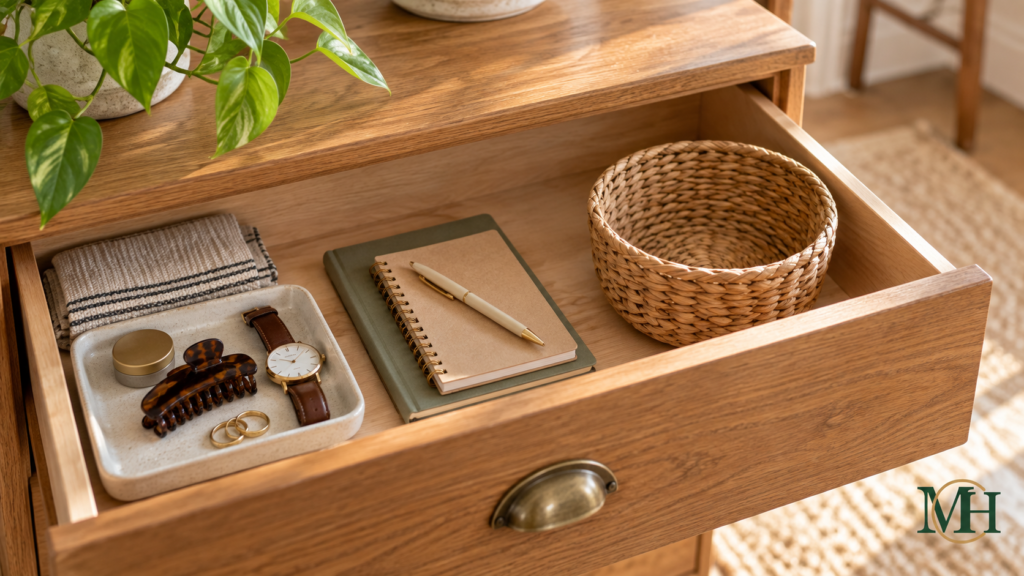
These things that do not need an organizer may need a decision before they need another container.
Organizers are useful when they make the things you genuinely use easier to see, reach and return. They are less useful when they become a way to avoid deciding what belongs in the home at all.
That distinction matters because storage products arrive with an appealing promise: buy the right bin and the clutter will become manageable. Sometimes that is true. A well-sized tray can make a hard-working drawer dramatically easier to use. But when a category is too large, outdated or disconnected from daily life, a container can only make the delay look tidier.
The calmer sequence is: decide first, define the space second and contain last. The five prompts below are not universal rules. They are invitations to look at familiar categories with fresh eyes.
This is also why clutter is not always a storage problem. A container can support a decision, but it cannot make the decision for us.
In our previous home, I kept adding separate bins for crayons, colored pencils, markers, watercolors, acrylic paints, paper—and every new school or craft supply that appeared. Each bin made sense on its own, but together they became a system I could no longer track or store comfortably. When we moved, school and craft supplies contributed more to our donation pile than any of us expected.
In the new house, I am testing a simpler structure: an organizer for each subject, plus one shared place for arts, crafts and miscellaneous supplies. The children can pull what they need for a subject and reset that smaller system when they finish, instead of returning materials to ten different bins. This is still evolving as their schoolwork changes, but the organizing structure now follows the way they work rather than every individual type of supply.
Things that do not need an organizer: five places to begin
1. Duplicate kitchen tools that do the same job
Duplicates are not automatically clutter. Two vegetable peelers might be useful in a household where people cook together. Extra measuring spoons can keep a busy kitchen moving. The more revealing question is whether each version is used often enough to earn its space.
Pull one narrow category at a time—spatulas, peelers, travel mugs or food-storage lids. Compare the items instead of evaluating them in isolation. Which one feels best in the hand? Which fits the cookware? Which comes clean easily? Which do you consistently move aside?
Keep the number your routines support. Then return the selected items to the drawer. Only after that should you decide whether a divider would improve access. This avoids buying an organizer sized for a collection you never meant to keep.
If the entire kitchen feels difficult, start with one frequently used zone instead of reorganizing every cabinet. This 10-minute kitchen reset shows the same small-area approach.
2. Paperwork whose useful life has ended
Paper often feels official long after it is useful. Old manuals, duplicate statements, expired warranties and reference sheets accumulate because each page seems too important to discard in the moment.
Start by separating records that may have legal, financial, tax, insurance or warranty value. Retention needs vary by document and jurisdiction, so use guidance from the relevant professional or issuing institution when you are uncertain. Protect personal information: shred or securely destroy sensitive documents rather than placing them intact in household recycling.
For the remainder, ask whether the information is current, available from a reliable source elsewhere and likely to be used. A labeled file box is valuable for records you need. It is not a reason to preserve obsolete instructions or duplicate copies.
3. School and craft supplies divided into too many separate bins
Children may genuinely need different papers, notebooks, pens, pencils, colors and art materials for different kinds of work. The problem is not the variety itself. The system becomes difficult when every material type acquires its own container and nobody can remember all the places supplies belong.
Try grouping around the workflow instead of the inventory. A subject organizer can hold the materials needed for that stream of schoolwork, while one shared arts-and-crafts area can hold supplies used across projects. The exact categories will depend on the children and their work; the useful test is whether they can find what they need and reset the system themselves.
Before choosing the containers, edit dried-out, duplicated, outgrown or unused materials. Donate only supplies a receiving organization currently accepts and can actually use. Then give the remaining categories enough room to change as school needs evolve rather than designing a permanent compartment for every pen or paint.
4. Guest supplies for a level of hosting you do not do
Hospitality does not require maintaining inventory for every hypothetical visit. A home that hosts two overnight guests once or twice a year may not need twelve spare pillows, several sets of specialty linens and a cabinet of travel-size products.
Plan for the guests you actually welcome. A clear limit might be one complete linen set per sleeping space, a small basket of basic toiletries and an extra blanket appropriate to your climate. Rare exceptions can often be handled by borrowing, washing between uses or making a purposeful short-term purchase.
The right amount is personal. The goal is not minimalism for its own sake; it is matching storage to a real pattern rather than an imagined obligation.
5. Decor kept only because it was expensive
The price paid for an object is real, but it cannot be recovered by keeping the object out of guilt. If a piece no longer suits the room, function or person living with it, storing it indefinitely adds an ongoing cost in space and attention.
Before letting it go, consider whether it can be used differently, repaired or moved to a place where it feels right. If not, choose the most responsible available exit: resale, consignment, gifting, donation or material-specific disposal. Be honest about the time and effort a resale plan requires. A high aspirational price can become another form of storage.
Photographing a meaningful object or recording its story may preserve what matters without preserving the object itself. But sentimental choices deserve time; no deadline is required simply because a category appears on a list.
A three-step decision before you shop
When you encounter a difficult shelf or drawer, pause before measuring for containers.
- Decide what belongs. Remove obvious rubbish, outdated material and items that belong elsewhere. Compare duplicates and identify what supports current routines.
- Define the boundary. Give the category a specific drawer, shelf or section. The boundary makes the available capacity visible.
- Contain for access. Add a tray, bin or divider only if it helps you see, reach or return what remains.
This order turns an organizer into a tool instead of a postponement. It also lets you shop with dimensions, quantity and purpose in hand, reducing the chance that the new container becomes clutter of its own.
The next useful step
Choose one contained area, not an entire room. Look for the category that has become hardest to close, return or maintain. Make the decisions first. Live with the edited category for a few days. If a container would then reduce friction, you will know exactly what it needs to do.
The goal is not a home with fewer belongings at any cost. It is a home where the space you have supports the life you are actually living.
If several home tasks are competing for attention, use this framework for prioritizing a home to-do list and choose the next visible action rather than starting every category at once.
Safety and professional caveats
Check a donation organization’s current acceptance policy before dropping items off.
Verify legal, tax and financial record-retention requirements with the relevant qualified professional or institution.
Securely destroy personal and financial information.
Follow local rules for electronics, batteries, chemicals, medicines and other regulated waste; do not place them in ordinary trash unless local guidance permits it.

