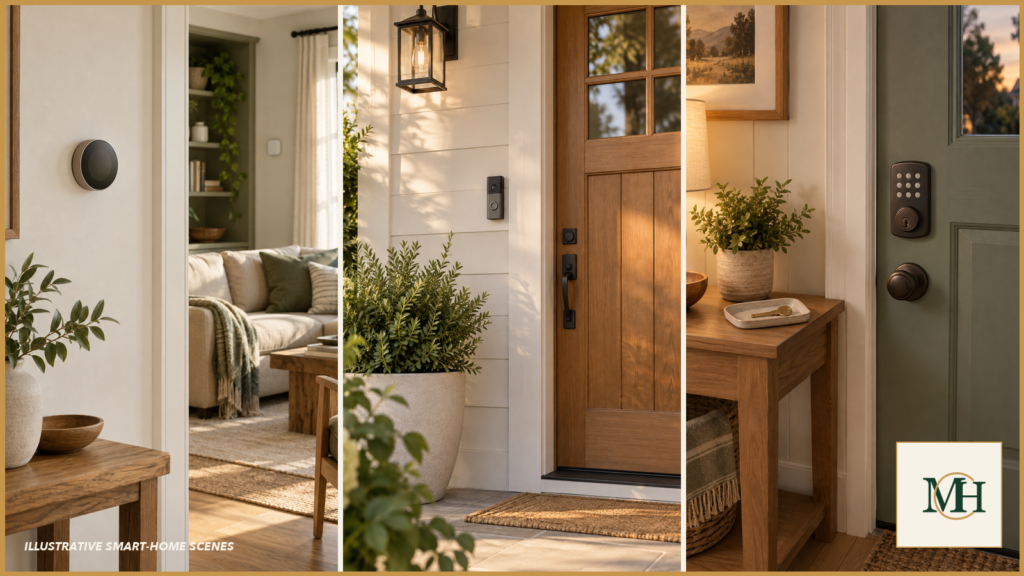
You don’t need a completely automated house to enjoy the benefits of smart-home technology.
In fact, starting small is often the best approach.
The most useful smart-home upgrades are the ones that solve an everyday problem—turning off lights you forgot about, adjusting the temperature when you’re away, checking who’s at the door, or making ordinary appliances easier to control.
If you’re new to smart-home technology, here are 5 simple smart home ideas worth considering.
1. Start With Smart Lighting
Smart lighting is one of the easiest ways to start making your home smarter.
Instead of simply turning a light on and off, smart bulbs or smart switches can give you more control over when and how your lights operate.
Depending on the system you choose, you can:
- Turn lights on and off from your phone
- Create schedules
- Adjust brightness
- Create different lighting scenes
- Control lights with voice commands
- Automatically turn lights on or off at certain times
For example, you could have your entryway lights turn on around sunset or create an evening routine that turns off selected lights when it’s time for bed.
You don’t need smart lighting throughout your entire house.
Start with one room or one frequently used light and see whether the convenience is worth expanding.
2. Add a Few Smart Plugs
Want to make an ordinary device smarter without replacing it?
That’s where smart plugs can be useful.
A smart plug connects between your wall outlet and a compatible device and can allow you to control that device remotely or according to a schedule.
You might use smart plugs for:
- Lamps
- Fans
- Seasonal decorations
- Holiday lights
- Certain small appliances
- Other compatible devices you regularly turn on or off
For example, instead of remembering to turn a lamp on every evening, you can create a schedule and let the smart plug handle it automatically.
Smart plugs are also a relatively simple way to experiment with home automation without committing to an expensive smart-home setup.
Just make sure the plug is rated for the device you’re connecting to it and follow the manufacturer’s safety instructions.
3. Consider a Smart Thermostat
A smart thermostat can be a useful upgrade if you want more control over your home’s heating and cooling.
Depending on the model and your HVAC system, you may be able to:
- Adjust the temperature from your phone
- Create heating and cooling schedules
- Make adjustments while you’re away
- Use occupancy or location-based features
- Monitor your home’s temperature remotely
The biggest advantage isn’t necessarily being able to change the temperature from your phone.
It’s automation.
Instead of manually adjusting your thermostat every day, you can create schedules that match your household’s routine.
Before buying one, however, check that the thermostat is compatible with your HVAC system. Some installations may require specific wiring or an adapter.
If you’re considering a smart thermostat, look for an ENERGY STAR certified model and check compatibility with your existing HVAC system before buying.
4. Make Your Front Door Smarter
Your front door is another area where smart technology can add both convenience and awareness.
A smart doorbell can allow you to see who’s at your door and, depending on the model, receive alerts when someone approaches.
Features can include:
- Live video
- Motion notifications
- Package or delivery alerts
- Two-way communication
- Remote access through your phone
Imagine you’re upstairs, working from home, or simply not near the front door.
Instead of wondering who rang the bell, you can check your phone and decide whether you need to respond.
When choosing a smart doorbell, don’t look only at the camera.
Also consider:
- Video storage
- Subscription requirements
- Wi-Fi coverage
- Wired versus battery installation
- Privacy settings
- Compatibility with your existing smart-home ecosystem
Choose a device that fits naturally into the way your household already works.
5. Bring Everything Together With a Smart Home Hub
Once you have a few smart devices, you may find yourself managing multiple apps and controls.
That’s where a compatible smart-home hub or platform can become useful.
Instead of controlling every device individually, you can create simple routines that make multiple devices work together.
For example:
Good Morning ☀️
A morning routine could:
- Turn on selected lights
- Adjust the thermostat
- Turn off overnight devices
- Trigger other compatible devices
Good Night 🌙
A bedtime routine could:
- Turn off selected lights
- Adjust the thermostat
- Lock compatible smart locks
- Arm compatible security devices
The goal isn’t to have dozens of connected gadgets.
The goal is to have the devices you already use work together.
You Don’t Need to Automate Everything
This may be the most important smart-home tip of all.
It’s easy to get carried away.
You start with a smart bulb. Then you add a smart plug. Then a thermostat. Then a doorbell. Then another hub.
Suddenly, you’re managing multiple apps, accounts, subscriptions and devices.
That’s not necessarily a smarter home.
Before buying a smart device, ask yourself:
What problem will this solve?
If there’s a clear answer, it may be worth considering.
If you’re buying something simply because it’s “smart,” you may not actually need it.
Start With One Small Upgrade
You don’t need to spend hundreds or thousands of dollars transforming your home.
Start with the everyday annoyance that bothers you most.
Forgotten lights?
Try smart lighting.
Want more control over your HVAC?
Look at a smart thermostat.
Want to automate an ordinary lamp?
Try a smart plug.
Want to know who’s at the door?
Consider a smart doorbell.
Already have several smart devices?
Look at a smart-home hub or platform that can connect them.
The goal isn’t to create a futuristic house.
It’s to create a home that works a little better for you.
A Smarter Home Doesn’t Have to Be Complicated
Smart-home technology is most useful when it quietly becomes part of your routine.
You shouldn’t have to think about turning the lights off, adjusting the thermostat, or checking whether someone is at the door. The right combination of devices can take some of those repetitive tasks off your plate.
And you don’t have to do everything at once.
Start with one problem. Find one solution. See how it works. Then build from there.
That’s often the simplest way to create a smarter home.
A Few Things to Consider Before Buying
Before adding any smart device to your home, take a few minutes to think about the bigger picture.
Compatibility: Will it work with your existing devices and smart-home platform?
Wi-Fi: Does the location have a reliable connection?
Privacy: What information does the device collect, and how is it stored?
Subscriptions: Does the device require a monthly or annual subscription for important features?
Security: Does the manufacturer provide security updates and allow you to use a strong, unique account password?
Long-term usefulness: Will this actually make your life easier, or will it become another device you have to manage?
A smart home should reduce friction—not create more of it.
Takeaway
Ready to make your home a little smarter?
Start small. Pick one everyday annoyance and find a simple solution for it. Smart lighting, thermostats and connected appliances can help automate everyday routines while giving you more control over energy use.
Save this checklist for your next home upgrade, and follow Modern Home Companion for practical ideas for a better home. 🏡