
Earthquake preparation can quickly turn into an endless list: supplies, plans, drills, furniture, documents and the structure of the home itself. All of those subjects matter, but you do not need to solve all of them before taking one useful step.
Start with the place where you spend time every day. Choose one bed, sofa or desk. Then look up, beside and around that spot for objects that could move, fall or break during shaking.
This is a household-contents check, not a structural assessment and not a complete earthquake-preparedness plan. Its purpose is simply to turn one vague concern into one observable next task.
First, choose one everyday spot
Do not begin with the whole house. Pick the place where you regularly sit, sleep or work:
- the side of the bed you use;
- the sofa or chair where your household spends the most time; or
- the desk where you work or study.
Stand at floor level and look from your normal position. Do not climb, pull on furniture or lift a heavy object to complete this check.
Look up: what is stored above you?
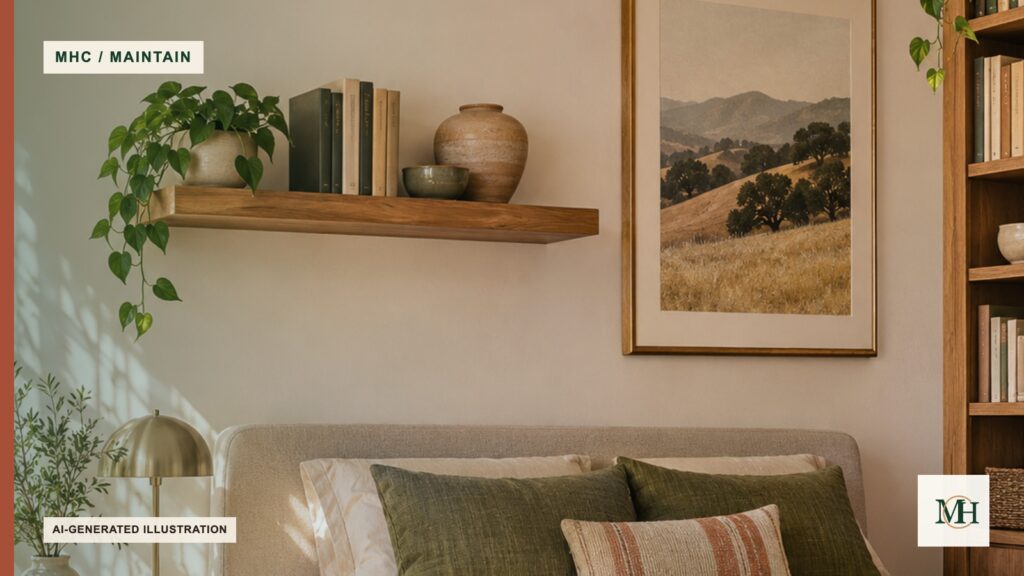
Notice shelves and ledges above or near your chosen spot. Look for substantial books, ceramics, glass, planters, electronics or other heavy and breakable objects stored high.
The CDC recommends placing heavy or large objects on lower shelves and checking items that could move, fall or break. That does not mean every object must be moved immediately. It means you have identified a useful question: would this item be better lower down, in another location or reviewed for a suitable restraint?
If the next step requires a ladder or moving something heavy, stop and ask for help. The observation can be yours even when the physical task should not be.
Look beside: what is tall or top-heavy?
Now look at bookcases, cabinets and other tall furniture beside the bed, sofa or desk. From a normal standing position, notice whether an item is tall, narrow or heavy at the top. You may be able to see a bracket or strap near the top, but do not pull, rock or test the furniture.
Visible hardware does not prove that an item is appropriately secured. The correct method depends on the furniture, the wall construction and the manufacturer’s guidance. If you are unsure, review the instructions for the actual item and wall or use qualified help.
Renting? Check your lease or ask your landlord or property manager before drilling or making a permanent change.
Look around: what is mounted nearby?
Finally, scan the wall and surrounding area. Notice mirrors, frames, televisions, speakers, clocks or other substantial objects mounted above or close to where you sit or sleep.
CDC guidance specifically calls attention to heavy mirrors and pictures above beds, chairs and other places where people sit or sleep. A useful next step may be relocating an object or reviewing whether its mounting is suitable for the item and wall.
Again, this is a visual check. Do not tug on mounted objects to test them.
Choose one next useful step
- Move it lower. A heavy or breakable shelf item may have a more suitable place below.
- Relocate it. A substantial object may be better away from a bed, sofa or desk.
- Review suitable anchoring or mounting. Use current instructions for the actual furniture, object and wall—or ask a qualified professional.
If your check identifies several tasks, record the others in your home-maintenance list. The goal today is not to make the room “earthquake-ready.” It is to finish one bounded observation and give the next decision a clear home.
For help deciding when a task should move up your list, use MHC’s guide to prioritizing a home to-do list. If the work exceeds your skills or carries meaningful risk, research before calling a home professional so you can describe the item, wall and question clearly.
Saveable one-room check
Copy this into your phone or home notebook:
- Spot: Bed / sofa / desk / other
- Up: Any heavy or breakable items stored high?
- Beside: Any tall, narrow or top-heavy furniture?
- Around: Any substantial mirror, frame, television or electronic item mounted nearby?
- Renter check: Lease, landlord or property-manager approval needed?
- Next step: Move lower / relocate / review suitable anchoring
- Help needed: Second person / manufacturer guidance / qualified professional
- Review date: ____________________
During shaking, use official guidance
This room check is something to do before an earthquake. During shaking, follow current official protective-action guidance: Drop, Cover and Hold On. The CDC advises dropping to hands and knees, covering your head and neck under a sturdy table or desk when possible, and holding on until the shaking stops.
A household plan, practice and appropriate emergency supplies still matter. For broader California preparation resources, visit the California Earthquake Early Warning preparedness page and the CDC earthquake preparedness guide.
One room will not complete your preparation. But one calm check can reveal one useful next step—and that is a credible place to begin.
Sources and boundaries
- CDC — Preparing for Earthquakes, directly verified November 12, 2026
- California Earthquake Early Warning — Get Prepared, directly verified November 12, 2026
This article provides general household observation guidance. It is not a structural inspection, installation certification or complete earthquake-preparedness plan. Follow current guidance for the actual item and wall; use qualified help where appropriate. Do not climb, lift a heavy item alone, pull on furniture or tug on mounted objects for this check. Images are AI-generated illustrations and do not depict a verified installation or an MHC home.

