
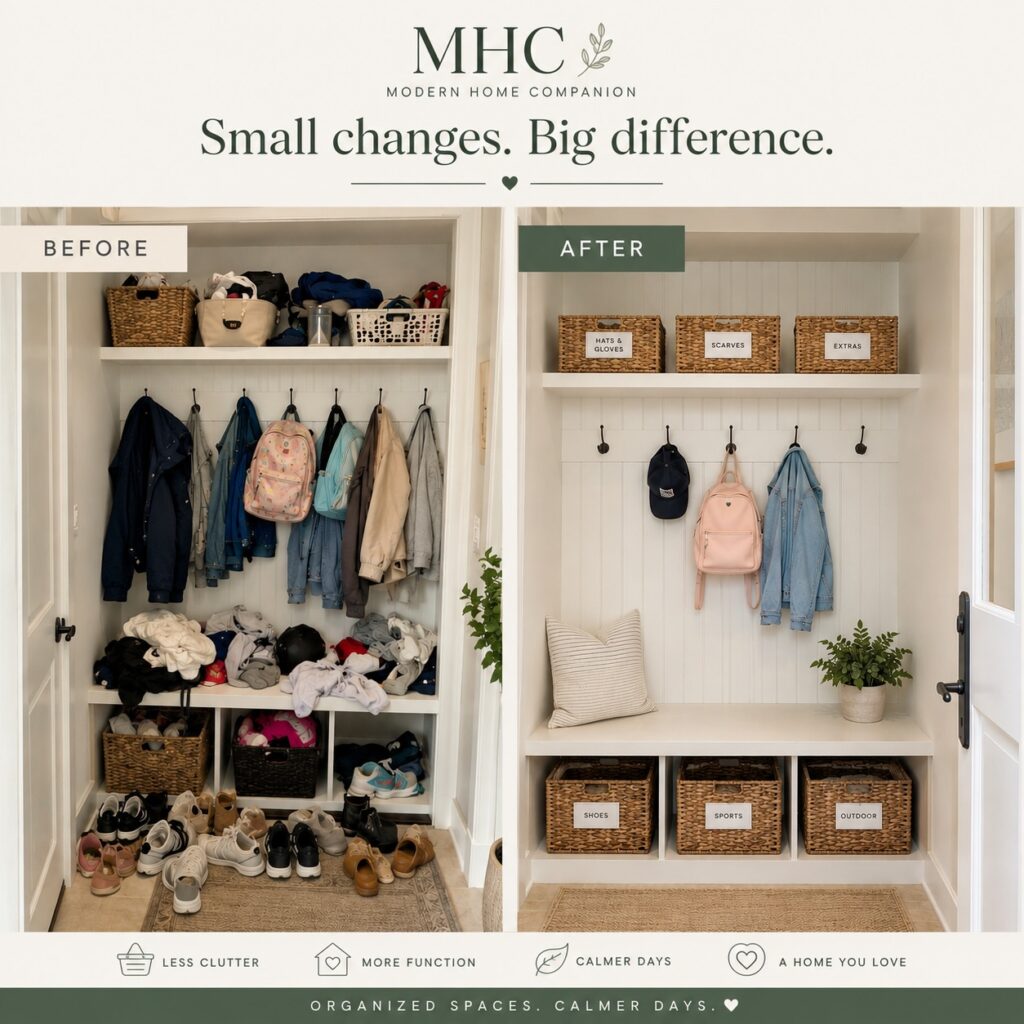
Does your drop zone become a drop-everything zone? Shoes collect by the door, bags fill every hook and the basket meant for small essentials becomes a place where things disappear.
An entryway drop zone works best when its job is clear: hold the things you need as you leave and give them an easy place to return when you come home. It does not need to store every coat, every pair of shoes or every item waiting for a decision.
This guide expands our entryway and mudroom Instagram post into five practical steps. Start with the doorway you actually use, whether it opens into a mudroom, a narrow hall or a corner of another room.
1. Give everyday shoes one designated spot
Look at where shoes naturally land. Choose a nearby place for the pairs currently in use, such as an existing shelf, suitable tray or section of a closet. Give occasional and out-of-season pairs another home so they do not crowd the daily ones.
Keep the door swing and walking route clear. A storage idea that requires stepping over shoes or squeezing past furniture needs adjusting. In a narrow entry, a clear section inside the nearest closet may work better than adding a bench.
If the shoe area keeps overflowing, revisit how many pairs belong there. A bigger container will not resolve a boundary that nobody can recognize.
2. Use baskets for specific categories
Baskets can make small belongings look less scattered, but each one needs a purpose. Choose categories your household actually uses: outdoor accessories, dog-walking supplies or items for a particular activity, for example. Keep categories separate enough that people can find and return things without digging through everything.
Avoid making one large “miscellaneous” basket the permanent answer. If an item belongs elsewhere in the home, take it there. If it is waiting for an action, give it a named next step instead of letting it disappear into the basket.
Try containers you already own before shopping. Our guide to things that do not need their own organizer can help you decide what needs reducing or regrouping first.
3. Label the categories so the system is shared
A label answers two questions: what goes here, and where does this go back? Use plain names such as “hats,” “school bags” or a household member’s name. For younger children, a simple picture can make the location easier to recognize.
Keep the categories broad enough to use quickly. If returning one item involves choosing between several nearly identical bins, combine categories and test again. The best label is one the people using the space understand without needing an explanation each time.
Place everyday items where the intended user can reach them safely. Follow the storage product’s mounting and load instructions, and keep heavy items in suitable lower storage.
4. Keep hooks for the jackets and bags in use
Hooks are useful for things that need a quick landing place. They become less useful when every coat, spare tote and rarely used bag stays on them indefinitely. Choose the current essentials and move the rest to their main storage location.
Use the hooks and fixings only as their manufacturer permits. A heavy backpack may need a different solution from a light jacket. Avoid crowding the doorway or putting items where they obstruct access to switches and other things you need to reach.
For keys or another small daily essential, a shallow dish or designated spot on existing furniture may be enough. Put it where the item is already being set down, provided that location is appropriate and secure for your household.
5. Add a short reset to the end of the day
The reset is a chance to restore the system, not reorganize the whole entryway. Return shoes to their spot, hang the jackets and bags that belong there, and take unrelated items to their proper rooms. Check anything waiting to leave the house so it has a clear next action.
Keep the routine small enough to repeat. If the same category overflows every evening, change its capacity or what is allowed to stay. If nobody uses a basket, check whether its position, label or lid is making the return harder than it needs to be.
Agree on who handles which belongings and any shared tasks. Our article on sharing household responsibilities explains why remembering and finishing the task matter alongside doing it.
No mudroom? Start with a small version
You can create a drop zone without built-in cubbies. Start with three existing places: one for daily shoes, one for the bag or jacket you use most, and one for small essentials. They can be in a nearby closet or on suitable existing storage rather than all on one piece of furniture.
Try the arrangement through a few ordinary arrivals and departures. Notice what is still left on the floor or moved to another surface. Adjust the location before buying a new organizing product. If furniture would narrow the route, keep the floor clear and use another appropriate storage location.
Make leaving and coming home easier
A usable entryway is one where you can find what you need, put it back and move through comfortably. Start with the category causing the most friction, give it a clear place and test that small change. You can add the next category once the first one works.
Save the original drop-zone post for the five-part reminder: shoes, baskets, labels, everyday hooks and a quick reset.
Featured image: AI-generated entryway illustration from the original MHC Instagram post. The before-and-after scene is conceptual, not a photograph of an actual renovation or the founder’s home.

