
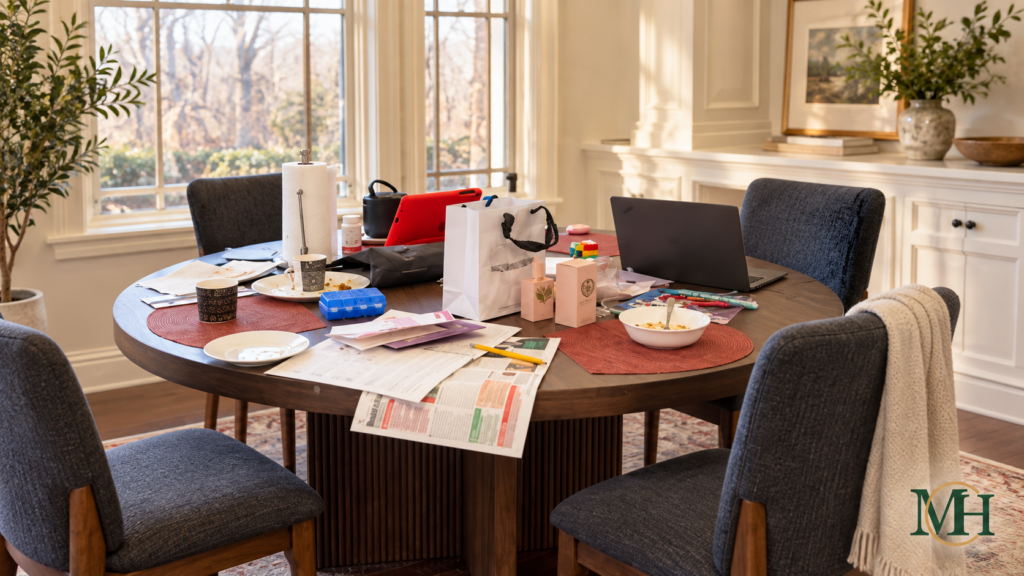
Understanding why empty surfaces attract clutter changed the way I approached the counters and tables in my home. Instead of seeing each new pile as a failure to stay organized, I began treating it as useful information.
In my house, almost every available surface seems to attract something. Kitchen counters collect cups and papers. Tables become landing places for keys, books and bags. Add children’s coloring supplies, pens, electronics and the things someone plans to put away “later,” and an empty space can become crowded surprisingly quickly.
The problem is not always a lack of discipline. Often, the surface is simply more convenient than the item’s designated home—or the item does not have a workable home at all.
Why empty surfaces attract clutter
An open counter or table offers the easiest possible next step: put the object down and continue with the day.
The proper destination may require opening a drawer, walking into another room, making a decision or asking someone else where the item belongs. When everyone is busy, the closest available surface wins.
That is why repeatedly clearing a table does not necessarily prevent the pile from returning. The reset addresses what you can see, but it may not address the reason those particular items keep landing there.
A pile can reveal:
- Items without designated homes.
- Storage that is too far from where the items are used.
- A routine that requires too many steps.
- Objects awaiting a decision or action.
- Storage areas that have reached their capacity.
- Household members following different systems.
The clutter is not a character flaw. It is a clue about where the current system creates friction.
My three-part reset system
I do not try to solve every organizational problem during one large cleaning session. Instead, I use three different reset points: daily, weekly and monthly.
Each one has a different purpose.
Daily: a 10-minute timed reset
At the end of the day, I set a timer for ten minutes and return visible items to their designated places.
The timer matters because it keeps the reset contained. I am not reorganizing drawers, evaluating every possession or attempting to clean the entire house. I am simply helping frequently used surfaces return to their intended jobs.
During this reset, I:
- Remove cups, dishes and obvious trash.
- Return keys, books, bags and supplies to their existing homes.
- Group items that belong in another room and move them together.
- Leave unresolved items for the weekly review instead of losing the entire evening to them.
Some evenings, the reset is complete before the timer ends. On busier days, ten minutes may only clear the most-used surface. Both outcomes are useful.
The goal is not a perfectly empty home. It is to make the next morning easier.
This approach is similar to the focused routine I use for my 10-minute kitchen reset: choose one useful area, restore its purpose and stop before the task becomes a full reorganization project.
Weekly: find workable homes for repeated items
During the week, certain objects may keep returning to the same counter or table. The weekend refresh is when I look at those patterns more carefully.
Instead of asking, “Why can’t we put this away?” I ask:
- Does this item have a designated home?
- Is that home close to where the item is actually used?
- Is it easy for everyone in the household to access?
- Is the storage already full?
- Is the item waiting for a decision?
- Would a hook, tray, drawer or basket make the next step easier?
If children’s pens repeatedly appear on the table, their official storage may be too far away or difficult to use independently. If keys always collect on a kitchen counter, a small landing place near the entrance may better match the family’s natural routine.
A designated home only works when it is practical. The weekly refresh gives me time to create or adjust those homes without turning the daily reset into a larger project.
Before buying another organizer, I try to use something we already own and test the location. A small tray or basket can help determine whether the system works before I invest in a permanent solution.
Monthly: review the unresolved pile
I also keep a temporary assortment area in the storeroom for items that did not find a clear home during the week.
This is not intended to become permanent hidden storage. At the end of each month, I review it and decide what should be returned, donated, recycled or responsibly discarded.
If we did not look for or use an ordinary item during the month, that is a strong signal that it may no longer support our daily life. However, I still consider seasonal items, important records, emergency supplies and sentimental belongings separately rather than discarding them according to a strict deadline.
For everything else, I ask:
- Did anyone need this during the month?
- Would we know where to look for it?
- Do we already own something that performs the same job?
- Is keeping it worth the space and future decisions it requires?
- Could someone else use it now?
A regular review prevents the temporary holding area from becoming another forgotten clutter zone.
Give every surface a primary purpose
It helps to decide what each frequently cluttered surface is primarily for.
The dining table may be for meals and family activities. A kitchen counter may be for food preparation. An entry table may be allowed to hold a small tray for keys and current mail.
The purpose does not have to produce a completely empty surface. It simply provides a boundary.
When a table is supposed to support meals, anything that prevents the household from sitting down comfortably needs another next step. When a counter is needed for food preparation, the goal is enough clear workspace to use it safely—not a showroom photograph.
Storage becomes more useful after deciding what truly belongs. As I learned when looking at why clutter is not always a storage problem, additional containers cannot resolve every delayed decision or unnecessary possession.
Do not organize the entire house at once
Choose one surface that repeatedly attracts clutter and observe it for a few days.
Notice what arrives first, who places it there and what each object is waiting for. Then make one repeated action easier.
You might:
- Add a small key tray near the entrance.
- Move art supplies closer to the table where they are used.
- Create one clearly labeled place for papers needing action.
- Place a return basket near the stairs.
- Reduce the number of mugs or supplies competing for storage.
- Schedule a short reset at a natural transition point in the day.
If the pile returns, treat that as feedback. The designated home may still be too far away, too full or too difficult to use.
A pile is a clue, not a character flaw
Empty surfaces will probably continue attracting objects because people need convenient places to pause during the day. The solution is not constant vigilance or a home where nothing can be left out.
A realistic system allows life to happen and includes a regular way to recover afterward.
For me, that means ten minutes each day to return familiar items, a more thoughtful weekend refresh for objects without workable homes, and a monthly review of the things we may no longer need.
Start with one surface—not the entire house. Notice what keeps landing there, make its next step easier and let the system improve gradually.
Watch the real-life version in the Why Empty Surfaces Attract Clutter Instagram Reel.
What always collects on your empty surfaces—keys, papers, cups, bags, children’s supplies or something else?

